Table of contents
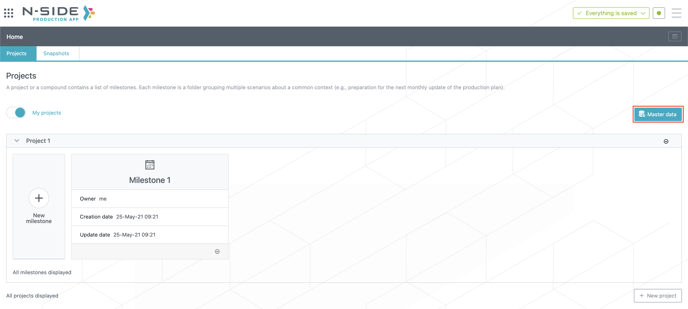
Master Data refers to the fundamental data building blocks that are shared across multiple projects. One Master data set is shared amongst all projects and seen by all users.
In other words, Master Data allows to:
-
Centralize different concepts and supply chain data.
-
Standardize data across multiple projects.
Adding new lines and updating “labels” in the Master Data can be done very easily.
Optimization strategies
Multiple optimization strategies can be defined to balance solving time and accuracy and to cope with the different project complexities. Tuning parameters for the optimization algorithm, i.e., Window, Time limit and Gap, can be used to balance speed and optimality.
-
Window: number of demands to add at each iteration.
-
Time limit: maximum computation time allocated for each sub-problem
-
Gap: quality of the solution of each sub-problem in terms of theoretical distance from optimality (the smaller the gap the closer to the optimality)
Studies
List of optional study characteristics that will allow to consolidate, sort and filter information in the result.
-
Study types: list of study types, a study (clinical or non-clinical) is associated to one study type (e.g., product stability, activity, efficacy).
-
Study status: list of study status, a study is associated to one study status (e.g.,planned, ongoing, on hold).
-
Study sponsors: list of study sponsors, a study is associated to one study sponsor (e.g., R&D, external).
-
Study indications: list of study indications, a study is associated to one study indication (e.g., epilepsy, insomia).
Products
List of product characteristics, some of which will allow to consolidate sort and filter information in the result.
-
Units: units used to define production quantities (lot sizes) for all types of products (e.g., mg, ml, vial).
-
Stage types: list of stage types, a standard production cost is associated to one stage type (e.g., drug substance, drug product, investigational medicinal product).
-
Product forms: forms that a product can have (e.g., bottle, capsule, lyophilisate).
-
Product states: states that a product can have (e.g., solid, liquid).
-
Product grades: grades that a product can have (e.g., technical, GMP). Studies are associated to a product grade such that only products from that grade can be used for the study.
-
Product purities: purities that product can have (e.g., base, salt).
Production sites
-
Countries: list of all countries where production sites (internal or external) are defined.
-
Departments: Production resources and demands (clinical or non-clinical) are attached to a department (e.g., clinical sciences & operations, clinical supply).
-
Production sites: production sites are production and/or storage sites. A production site can be either internal or external (outsourced). Production resources, inventory resources and demands are associated to a production site. Shipment resources are defined from production site to production site.
Costs
-
Cost types: list of cost types, a standard production cost is associated to one cost type.
-
Standard production costs: list of standard production cost models that can be used to derive the fixed and variable costs for production resources.
|
Manufacturing costs are an important input for the production plan optimization since they constitute the main objective to minimise. These costs are typically entered at the project level for each resource and product involved. Yet, in some cases this information might not be easily available to the user of the system. The standard costs listed in the Master Data can then be used as a replacement. |
The model uses the total cost of manufacturing of two lots of different sizes (small and large) to determine the variable and fixed parts of the cost. Cost models can be defined for any stage type (DS, DP, IMP). A standard cost model can be attached to a production resource only if all products that can be produced by the resource are of the related stage type and unit.
Useful links: