![NSIDE_SupplyAPP_FullColorGray_Logo.png]](https://knowledge.n-side.com/hs-fs/hubfs/content-lifeSciences/Logos-LS/NSIDE_SupplyAPP_FullColorGray_Logo.png?height=40&name=NSIDE_SupplyAPP_FullColorGray_Logo.png)
Table of contents
Complex lot allocation can sometimes lead to risky situations, especially if it’s not aligned with label groups. These risky situations, and how to resolve/avoid them, will be explained in this article. First, it seems important to have a quick reminder on how the N-SIDE Suite works to resupply depots.
Resupply rule
ℹ️ The resupply rule is that the system will trigger a shipment if : inventory ≤ trigger level (inventory = stock + kits in transit).
In that case, the resupply quantity = resupply level – inventory.
The trigger level (or min buffer level) will be used to trigger shipments whenever the stock on depot reaches levels that are too low. The trigger level is computed to cover the sites demand (prediction kits and buffers) during the short window (covering a bit more than just a lead time).
The resupply level (or max buffer level) will be used to compute the quantity to send to depots when a shipment is raised. The resupply level is computed to cover the average sites demand (prediction kits and buffers) during the prediction window.
For each package type, the system will independently check an inventory per label group which allows to have all label groups represented in sufficient amounts in the total inventory with no unnecessary overage. In other words, the system will check an inventory per product (combination of package type and label group).
Why not an inventory per depot? If the system had an inventory per depot, there would be no way to make sure that all label groups are represented in sufficient amounts in the inventory.
Why not an inventory per country? If the system had an inventory per country, it would significantly increase the overage.
Specific cases
First, let’s take a simple network example where we have central depot supplying a local depot that supplies four countries (Belgium, France, Italy and Spain) divided in two label groups :
-
Label group 1 (LG1) : BEL + FRA
-
Label group 2 (LG2) : ESP + ITA
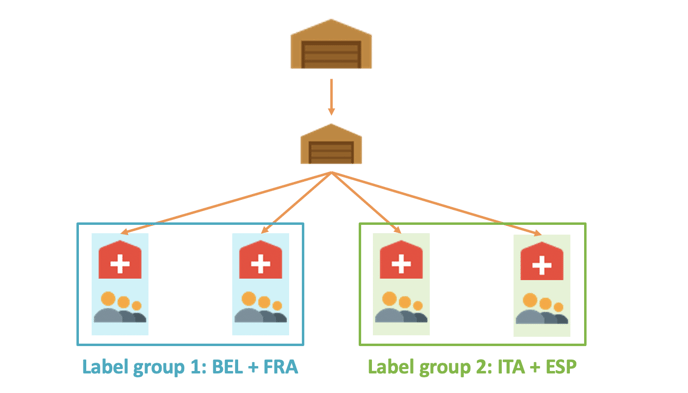
The total inventory at the local depot will thus be divided in two : 1 inventory for LG1 and 1 inventory for LG2. The system will send lots according to the countries defined in their product(s) label group(s). Regarding the lot allocation, as lots that are in inventory do not have a label group in the IRT data extracts, the system needs to have a lot allocation defined for those lots to know where to send them.
The easy case is when the countries are the same as in the label groups (see example below).
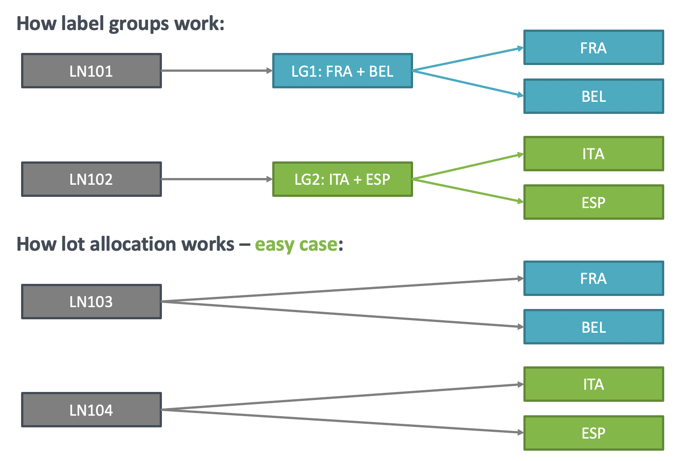
However, sometimes lots can be restricted to one country or can be sent to additional countries that are not part of their respective label groups.
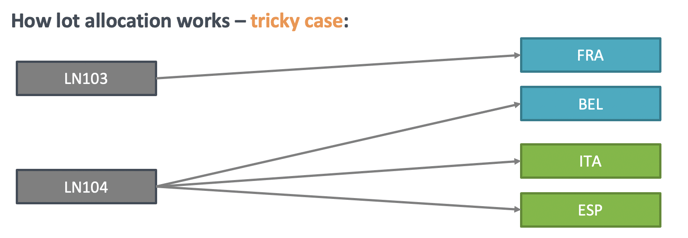
The example below shows these two cases :
-
Lot LN103 can only go to France (LG1).
-
Lot LN104 can go to ITA + ESP (i.e. LG2) but can also go to Belgium (LG1).
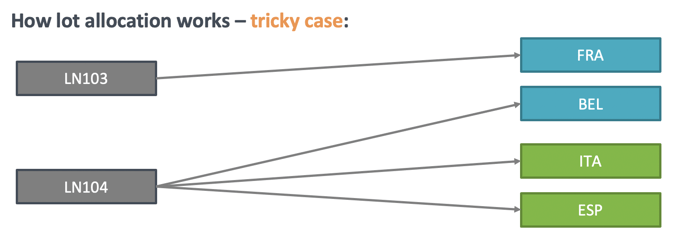
These cases could cause some trouble as:
-
LN103 will be counted as inventory for LG1 for the resupply check, despite not being suitable for BEL.
-
LN104 will be counted as inventory for LG1 (as it comprises Belgium in its lot allocation) and LG2 for the resupply check, but each kit can only be used once.
Case 1 : Lot allocation for lots with the same expiry date
Let’s take a first simple case (see image below) where we have a local depot supplying four countries (France, Spain, Portugal, and the Netherlands).
-
France was already in the trial from the beginning
-
3 new countries were recently added to the trial: Spain, Portugal, Netherlands.
There are two lots of the same kit type in inventory:
-
Lot-101 can only go to France.
-
Lot-102 can go to all countries.
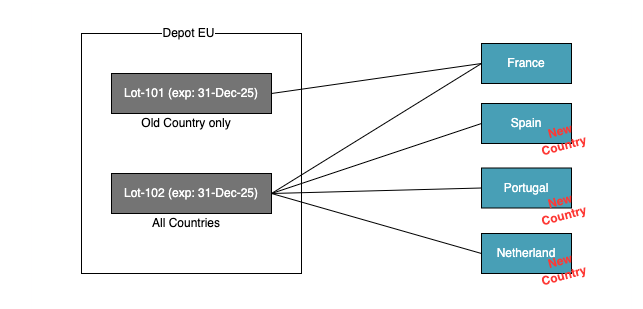
This case could actually cause risks of missed visit:
The system will check the expiry dates of both lots, and as they are the same, it will randomly choose one to fulfill the demands. As a result:
-
It will not necessarily prioritize the use of Lot-101 for France over Lot-102.
-
It will not necessarily prioritize Lot-102 for new countries and avoid sending it to France while Lot-101 is still available.
Therefore, there is a possibility that Lot 102 may be used for all countries including France first and, once depleted, only Lot 101 could remain (with a restricted lot allocation to France) leaving Spain, Portugal and Netherlands potentially at risk.
❗The solution here is to push the expiry date of the Lot-102 by 1 day. The system will then prioritize the usage of Lot-101 to fulfill demand to France. When sending kits to the other countries, it will consider the lot allocation constraint and send Lot-102.
Case 2 : Lot allocation excluding country(ies) from label group(s)
Let’s take a second case where LN103 is only eligible to go to France. As its lot allocation is France, its label group is therefore LG1 : FRA + BEL and it will be counted in the LG1 inventory.
Let’s take an example where we have 187 kits of LN103 at the local depot and where the trigger level is set at 100 kits. The resupply rule is that the system will trigger a shipment if : inventory ≤ trigger level. In this example : 187 > 100, therefore the check is good and there is no need to resupply.
But is it really the case? The lot LN103 is counted in the inventory of LG1 (FRA + BEL) thus the kits included in it are counted as “French and Belgian” kits but they actually cannot go to Belgium! Therefore, if there is a real need of kits in Belgium, no shipment to Belgium will be triggered as the inventory check was good and this could lead to risk in that country.
❗In this case, the only solution to mitigate this risk is to create planned shipments to the local depot with kits that can actually go there.
Case 3 : Lot allocation comprising a country from another label group
Let’s now take a third case where LN104 can go to ITA + ESP (i.e. LG2) but can also go to Belgium (LG1). This lot will therefore be counted for the resupply checks of both LG1 and LG2.
Let’s take an example where we have 105 kits of LN104 at the local depot and where the trigger level is set at 100 kits for both LG1 and LG2. The resupply rule is that the system will trigger a shipment if : inventory ≤ trigger level. In this example : 105 > 100 for both label groups, therefore the check is good for both and there is no need to resupply. 
However, as LN104 can go to Belgium, kits that are going to be sent to Belgium will be taken from the LG2 inventory! This means that the LG2 inventory might not actually cover the sites demand that can happen during the short window in one or several supplied countries (i.e. the trigger level might be too low), which could lead to risk.
❗The solutions here are to create planned shipments to Belgium with another eligible lot or to increase the short window. However, the latter should be considered carefully as it could increase the overage.
In both cases, it is important to note that the risk will last until all kits from those “misaligned” label groups are either dispensed or expired. Moreover, the risk can carry on if the next shipped lots have similar lot allocation “issues”.
Case 4 : Lot allocation comprising all countries from two (or more) label groups
For this last case, we will take another network configuration with a central depot supplying two local depots and with a label group per local depot (see example below).
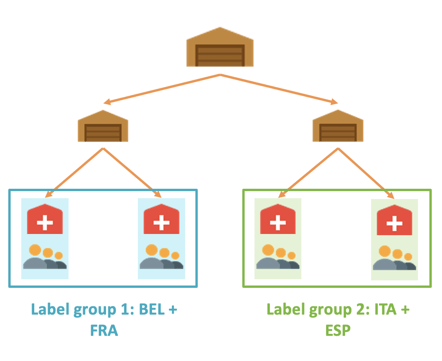
In this case, two lots have different expiry dates and one lot (LN106) includes all countries from both label groups (see example below).
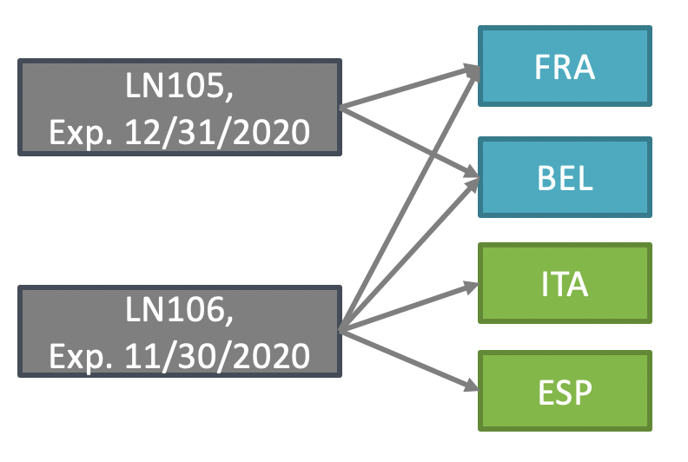
What happens if the BEL + FRA local depot is in need of kits? In this case, both lots are eligible to be sent to the local depot and the system will send kits from the lot with the shortest expiry i.e. LN106. Indeed, a shipment priority is based on expiry.
However, this could deplete the central depot which could be left with lot LN105, which cannot go to ITA + ESP, therefore potentially leading to risk in Italy and/or Spain. This will also lead to an increased overage due to an increase in waste of kits from LN105.
❗The solutions here are:
-
To create planned shipments to Italy/Spain with LN106 before it is sent to Belgium/France
and/or
-
To create planned shipments to Belgium/France with LN105 so that this lot is used instead of LN106.
Good practices
💡 Depending on the trial configuration, the ideal solution to avoid resupply issues related to label group/lot allocation, is to have a single label group for the whole trial.
In case it is not possible, you can still follow these good practices :
-
For each depot, try to have the lot allocation aligned with the label groups of the countries supplied by the depot.
-
Take the time to properly enter & check lot allocations.
-
Don’t hesitate to contact the N-SIDE Service Desk for support if blocked/unsure/unable to understand results.