![NSIDE_SupplyAPP_FullColorGray_Logo.png]](https://knowledge.n-side.com/hs-fs/hubfs/content-lifeSciences/Logos-LS/NSIDE_SupplyAPP_FullColorGray_Logo.png?height=40&name=NSIDE_SupplyAPP_FullColorGray_Logo.png)
Table of contents
Recruitment assumptions
In the recruitment assumptions tab you define three key inputs:
-
How the recruitment is defined: is it by numbers of patients screened or randomized?
-
The recruitment rates, per country. You can be as precise and specific as desired here, as the recruitment rates are defined per country and split into recruitment periods. A recruitment period can be the whole recruitment duration, or a few days. The periods also do not have to be the same for all countries.
-
The fallback recruitment, that will be used if the simulations reach the end of the recruitment periods in a country but the recruitment target has not been hit yet. In those conditions, the recruitment will continue according to the fallback rate, defined as: Number of patients / (number of months of enrolment * number of sites). It can be seen as a back-up input for recruitment, and should not be too small in order to prevent a slower end of recruitment.
Inputs #2 and #3 are defined per patient group and are function of what you selected between patients screened and patients randomized. Patient groups are defined in the Trial Master Data, and can be used here to define cohorts recruitment for example.
During the simulations the recruitment figures will be used with some variability. This means that countries will recruit slower or faster at the defined rate, depending on the simulation. If enough simulations are run, the average will be corresponding to what is defined.
Recruitment graph
The recruitment graph is built from data entered in the table below it.
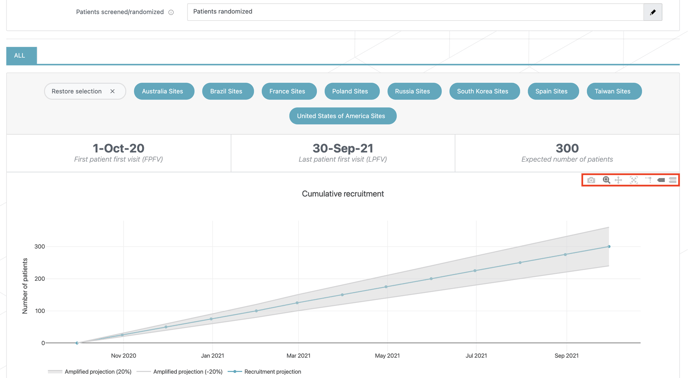
Different actions can be perform with the graph by clicking the different icons at the top right of it. From left to right (see image above):
-
Take a snapshot (.png) of the graph
-
Select a portion of the graph to zoom in
-
Navigate the graph
-
Autoscale (useful after having zoomed in)
-
Toggle spike lines
-
Show closest data from the 3 lines on hover
-
Show compared data between the 3 lines on hover.
Recruitment constraints
In the recruitment constraints tab, you will define the constraints to apply on the recruitment.
They can be of two kinds:
-
The recruitment floor can be seen as a target. It can be applied on a single country, a group of countries or all countries in the trial. The recruitment will continue in the related countries as long as the floor number has not been reached.
-
The recruitment cap can be seen as a ceiling. It can also be applied on single or multiple countries. The recruitment will be stopped in the related countries as soon as the cap is reached (taking into account the already randomized patients + all the patients actively in screening). The cap cannot be exceeded. Note that the cap will be shared among countries if several countries are defined in the same row.
The constraints can be defined in terms of patients screened, randomized or who have completed the treatment but there needs to be at least one constraint defined: the global recruitment target that is a floor defined for all countries at once.
💡 Tips
-
If there are multiple constraints applied on the same country(ies)/patient group(s), they have to be compatible.
-
For example: a country/patient group cannot have a floor of 13 patients and a cap of 11.
-
-
Moreover, if a floor is set for a country(ies)/patient group(s) that is (are) a subset of countries/patient groups for which a cap is defined, they also have to be compatible.
-
For example: if you have a cap of 10 for patient groups A and B, and a floor of 1 for group B only. If patient group A recruits 10 patients before patient group B recruits one patient, patient group B will never reach its floor.
-
Site activations
In the site activations tab, you define when the sites will open in the trial. It will be done per country and over periods of time, as it is done for the recruitment. The periods do not have to be the same as in the recruitment assumptions tab but they need to be consistent. For example, recruitment cannot be defined at a time when no sites are opened.
In the simulations, sites will open with some variability on the timing. During the site opening periods, sites will be open at random, however there is a guarantee that the right amount of sites is open at the end of each period.
This means that the longer the site opening periods, the more variability on the site openings and on the recruitment.
❗Make sure to define patients arrivals in screening when sites are already opened and define a sufficient number of sites to be opened in regards to the number of patients recruited.
Indeed, with a very low expected number of site opened, or a very low chance of screening success, respecting recruitment rates (which appear reasonable) may lead to unwanted results.
Expectations to screen a dozen patients in average in a given country/region may translate, in extreme cases, to thousands of patients enrolled. Whether because the screen fail is high or because sites are unlikely to be opened during that time.