![NSIDE_SupplyAPP_FullColorGray_Logo.png]](https://knowledge.n-side.com/hs-fs/hubfs/content-lifeSciences/Logos-LS/NSIDE_SupplyAPP_FullColorGray_Logo.png?height=40&name=NSIDE_SupplyAPP_FullColorGray_Logo.png)
Missed dispensing and out-of-stocks are two very different risk metrics, in that they are symptoms of different supply chain problems, and require different mitigation actions.
Missed dispensing risk occurs when a patient shows up for a visit and cannot receive either a part or the entire expected dispensing for that visit, with kits still available elsewhere in the supply chain (central and/or local depots) at that time. Put differently, missed dispensing risk will appear if there is a shortage at site, or at site and at local depot, but it is possible to react by expediting shipping of the missing kits.
Typically, missed dispensing risk is the result of an inadequate site resupply strategy.
This is usually the case when:
-
Buffer levels are too low, and unpredictable demand cannot always be satisfied.
-
Buffer levels are too high, in such a way that the local depot will be emptied before the arrival of the next depot shipment.
-
Site prediction windows are too long, in such a way that the local depot will be emptied before the arrival of the next depot shipment.
-
Production overlap (which is the timespan between the expiry date of kits from packaging run X and the release date of kits of packaging run X+1) is insufficient, causing difficulties to replace expired kits on time. An insufficient production overlap causes missed dispensing risk when the ‘new’ kits are released before the expiry date of ‘old’ kits, but not early enough for them to be delivered to local depots or sites on time for the replacement of old kits.
By contrast, out-of-stock risk occurs when a patient shows up for a visit and cannot receive either a part or the entire expected dispensing for that visit, and there are no kits available for shipment in the entire upstream supply chain at that time. In other words, out-of-stock risk will appear when there is a shortage at site, local and central depot at a given time, meaning it is much harder to react.
Out-of-stock risk can be the result of both an inadequate site resupply strategy and wrong IMP release plan decisions.
Typical root causes include:
-
Too high buffer levels or prediction windows, causing local depots and central depot inventories to deplete ahead of the next IMP release.
-
Insufficient production quantity for an upcoming IMP release, causing a shortage of kits in the entire supply chain before the release of the next packaging run.
-
Insufficient production overlap, or delayed packaging run, causing kits currently in inventories to be unusable due to expiry before the new kits are released.
When simulation results show missed dispensing and/or out-of-stock risk, a good practice is to look for the root cause by identifying:
-
The countries in which missed dispensing is reported
-
The depots associated with out-of-stock risk
-
If several package types are used in the trial, the specific package type(s) for which risk is expected
-
The timing of risk occurrence
Such information can be found very easily in the Result dashboard of any available simulation result, more specifically under the Risks tab where it is possible to filter risk statistics by kit type, country, depot, and time period.
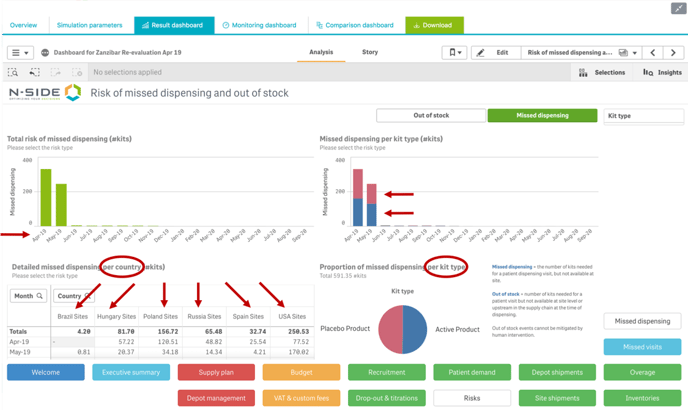
Finding such information will provide pointers on the appropriate risk mitigation action(s) to be taken (e.g. adapting buffer levels or long window at sites, changing IMP release plan timelines, etc).