![NSIDE_SupplyAPP_FullColorGray_Logo.png]](https://knowledge.n-side.com/hs-fs/hubfs/content-lifeSciences/Logos-LS/NSIDE_SupplyAPP_FullColorGray_Logo.png?height=40&name=NSIDE_SupplyAPP_FullColorGray_Logo.png)
Table of contents
First shipment
In this separate step, you can define what should be sent as an initial shipment, to sites and/or depots, and when (for sites only).
First shipment quantities
You can define, per location and kit type, what quantity of kits should be sent at the initial shipment.
❗If the quantity is not defined for certain locations (sites and/or depots) and/or kit types, the initial shipment will contain quantities equivalent to the resupply level (defined by the user or computed by the system, during simulations, if not defined by the user).
First shipment rule
You can define if the initial shipment at site will be sent at site opening or when the first patient is screened/randomized. You can also define different rules for different package types. For example, you can model particular cases where all package types are sent everywhere at first patient randomized except for the SOC package type that can be sent at site opening to the US sites (see image below).
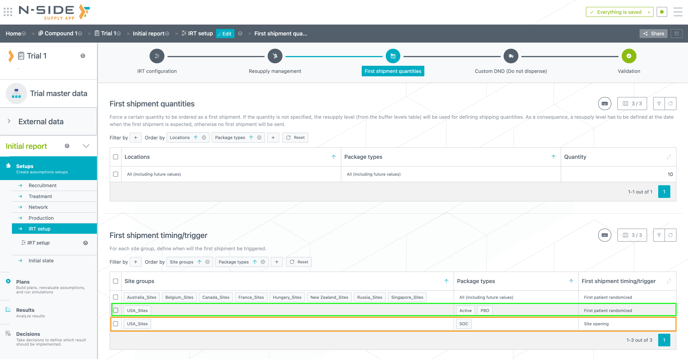
First shipment at site opening will trigger the initial shipment one lead time before the site opens, so that the inventories are on site as soon as it is open for recruitment. As a reminder, the site opening dates are defined in the Recruitment setup.
First shipment at first patient screened will trigger the initial shipment on the day of the first patient recruitment. It is an option that can help reduce the waste on the trial, as no kit will be sent on sites that never recruit, or start recruiting after the initial kits are expired.
However, it requires the trial to have two key properties:
-
No dispensing at screening.
-
The time between screening and the first dispensing (typically the screening period) should be longer than the lead time to sites.
❗If one of these conditions is not met, there will be risk induced in the trial when selecting this option.
First shipment at first patient randomized will trigger the initial shipment on the day of the first patient randomization. It is an option that can help reduce the waste on the trial, as no kit will be sent on sites that never recruit or start recruiting after the initial kits are expired or when the screening failure is high.
However, it requires the trial to have two key properties:
-
No dispensing at screening or randomization
-
The time between randomization and the first dispensing should be longer than the lead time to sites.
❗If one of these conditions is not met, there will be risk induced in the trial when selecting this option.
💡Tip
It is possible to define different rules for different site groups, e.g. the first shipment can be sent at site activation in China, and at first patient screened in the USA.Do not dispense
In this table, you can setup do not dispense (DND) values per patient group, treatment arm, visit, package type and dose level.
The visit that you enter is the visit from which the DND value starts.
For example, if for a specific patient group/treatment arm/package type/dose level, you have a DND of 14 days between visit 1 and visit 2 and between visit 2 and visit 3, you enter visit 1 and visit 2 for this row. If the DND value then changes to 21 days between visit 3 and visit 4, you create a new row for visit 3.
💡Tip
It is strongly recommended to use this feature in case the usability period of a package type is different from “one day” or “next visit” (see Network setup ).
Specific use case: Automated supply scheme
For some IRT, an “automated supply scheme” is activated. This algorithm will define the level of buffers according to the number of patients in screening on the site.
This strategy works like the smart prediction except that kits for the smart prediction are allocated for the randomization visit (DNS for the Randomization visit) while the automated supply scheme would send “buffers” and therefore considers the worst case DNS.
To mitigate that with the N-SIDE Suite, the Custom DND tab (from the IRT setup) should be used. The longest DND should be assigned to a “fake visit” in order to have the correct DNS for the kits sent at screening.
