
Table of contents
Context
The smart predition (or prediction of the randomization) is a modelling technique that mimics an IRT system that would, thanks to the prediction algorithm, send kits to sites only when patients are screened. Indeed, we are aiming at sending precisely what the patient would need for randomization, to avoid stacking up sites with buffers.
✅ The main advantages of this modelling are:
-
Decreasing the overage by removing buffers at site levels (except for safety kits if they are needed)
-
Decreasing the risk at the randomization visit as all kits will already be on site when the patient is randomized
-
No need to adjust manually sites buffers levels regardless of how many patients are in screening, as everything is automated and no buffers are required.
It is particularly interesting to use this technique for a trial with these characteristics :
-
Expensive package types and low cost shipments
-
Low screening failure
-
Weight ranges (even more if associated to small probabilities) as the weight of the patient will be usually known at the screening visit and therefore the number of kits needed to be sent for this patient.
-
Short expiries (buffers do not need to be replaced)
❌ The main drawback of this modelling is that it will not always be optimal. Particularly for trials with these characteristics:
-
Expensive shipments and cheap package types
-
High screen failure
-
Very long expiries (the smart prediction will have less impact than with short expiries)
⚠️ The main condition to implement this technique is that the screening period must be longer than the lead time to site (for each site). Otherwise, patients could be randomized before the kits will reach the site and therefore miss their dispensing.
In all cases, the impact of the modelling on a trial will depend on the trial design and will be impacted by :
-
The screening failure rate: It will influence the number of shipments and kits sent to sites.
-
The cost of kits vs. cost of shipments
-
The duration of the recruitment and the number of patients per site: It will influence the number of expiry replacements.
-
The number of treatments arms and the number of kits dispensed
-
The number of different kit types
Process
Since Supply.2022.4 it is more easy to setup a smart prediction in the Supply App.
Go to the Randomization tab of the Treatment setup and choose Predict all as the prediction mode for randomization. This way, the system predicts kits for all possible dispensing at randomization (and only for the randomization visit).
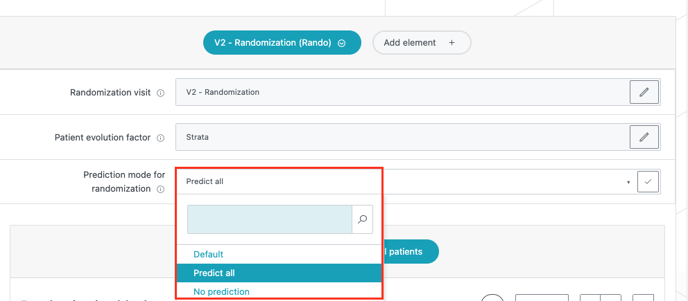
If only the randomization needs to be predicted, then you are all set.
If you need to predict subsequent visits to the randomization visit you can use the Custom prediction table of the Prediction tab.
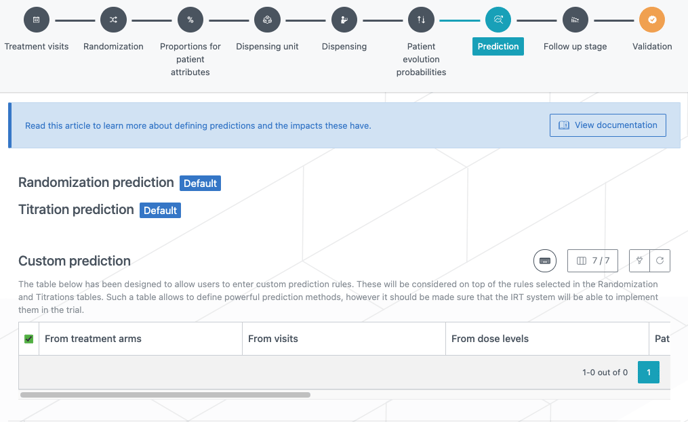
The standard prediction is usually activated upon randomization only, so if the second dispensing visit is happening less than 1 lead time after randomization, it needs to be predicted before (or covered by buffers).
For example, if you need to predict the visit (“visit 2”) after randomization, you can do it so by entering the randomization visit in the From visits column and “Visit 2” in the To visits column. Don’t forget to also reference the associated treatment arms, dose levels and patient evolution categories.
✅ Good practice
All visits happening less than one lead time after the randomization visit must be predicted in the custom prediction table if a smart prediction is implemented.
Specific use case: Automated supply scheme
For some IRT, an “automated supply scheme” is activated. This algorithm will define the level of buffers according to the number of patients in screening on the site.
This strategy works like the smart prediction except that kits for the smart prediction are allocated for the randomization visit (DNS for the Randomization visit) while the automated supply scheme would send “buffers” and therefore considers the worst case DNS.
To mitigate that with the N-SIDE Suite, the Custom DND tab (from the IRT setup) should be used. The longest DND should be assigned to a “fake visit” in order to have the correct DNS for the kits sent at screening.
